
Make Iran a Nation Again
The War on Globalism Comes to the Islamic Republic

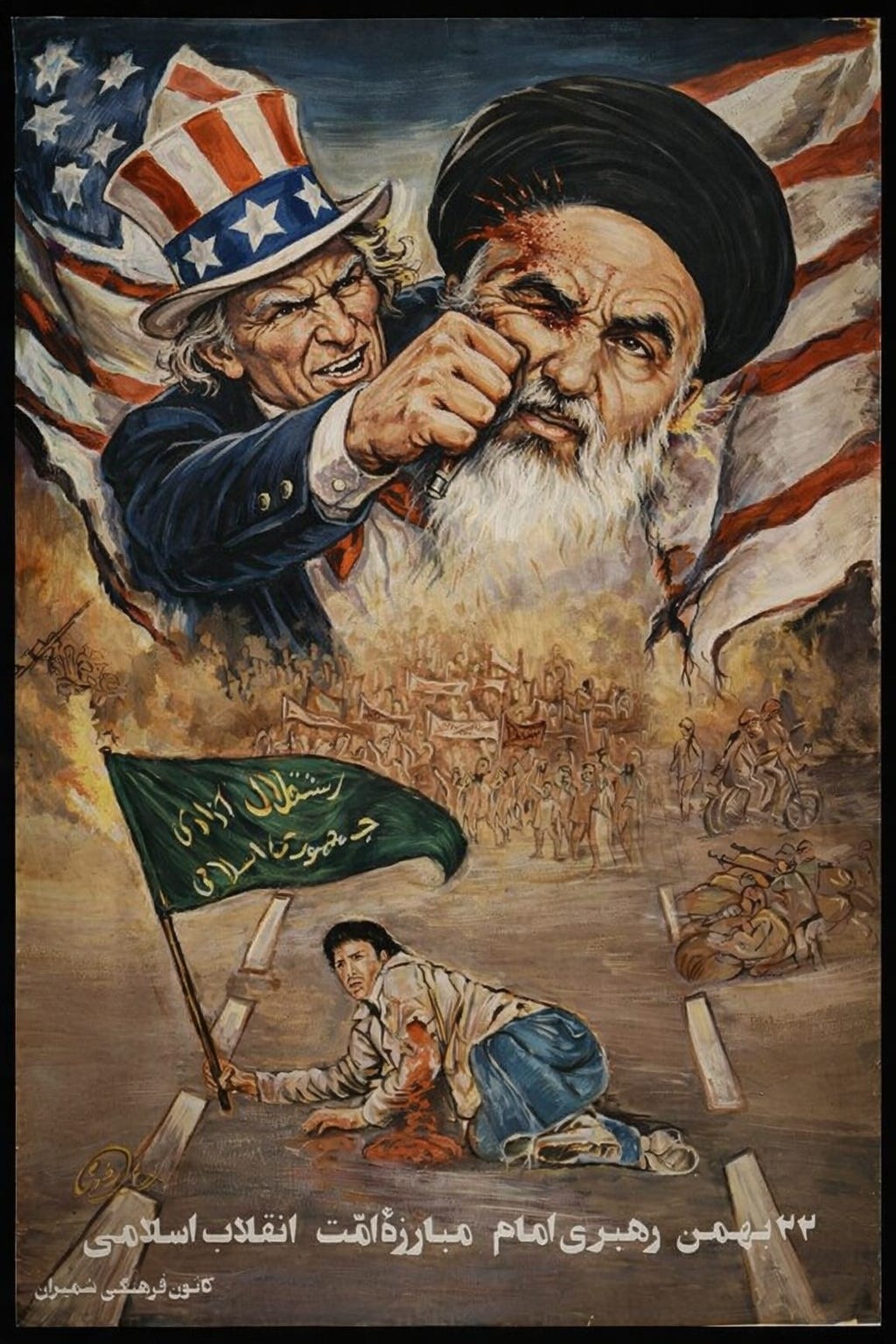
Totalitarian movements are globalist, not nationalist. They may make use of nationalism instrumentally, but their ambitions can’t be confined to a delimited people and territory. As Hannah Arendt writes, “the totalitarian movement seizes power in much the same sense as a foreign conqueror may occupy a country which he governs not for its own sake but for the benefit of something or somebody else.”1 Communists ruled to build a workers’ paradise and destroy capitalism. The Nazis ruled to create a master race and exterminate the Jews. Stalin’s doctrine of “Socialism in one country” prioritized Soviet internal development over immediate worldwide revolution. Yet he exploited every opportunity he had to spread communism, whether through directing foreign parties via the Comintern, establishing Soviet-aligned governments in Eastern Europe after World War II, or backing Mao in China and Kim Il-Sung in Korea. Hitler was ostensibly a National Socialist, but thought in pan-racial (“Aryan”), not national, terms.2 As historian Timothy Snyder writes, “He’s quite consciously manipulating German national sentiment to get to power and then to start the war, which he thinks will transform the Germans, as it were, from a nation into a race.” In the end, Hitler prioritized committing genocide over winning World War II and ordered the destruction of Germany when it became clear that the Germans were unworthy of racial dominance.
Likewise, though it sometimes exploits nationalist sentiment and feigns moderation, the Islamic Republic of Iran is, at its core, a totalitarian globalist entity. Per Arendt, totalitarian rulers “consider the country where they happened to seize power only the temporary headquarters of the international movement on the road to world conquest . . . global interests always overrule the local interests of their own territory.”3 On that note, here are the megalomaniacal words of Ayatollah Ruhollah Khomeini, father of Iran’s 1979 Islamic Revolution, upon the conclusion of the Iran–Iraq War in 1988:
We have repeatedly shown in our foreign and international Islamic policy that we have been and are intent on expanding the influence of Islam in the world and lessening the domination of the world devourers. Now, if the servants of the United States cite this policy as being expansionist and motivated to establish a great empire, we will not fear it but welcome it.
We are intent on tearing out the roots of corrupting Zionism, capitalism, and Communism in the world. We have decided to rely on God Almighty to destroy the regimes which are based on these three pillars, in order to spread the regime of the Islam of the messenger of God—peace be on him and his scion—in a world of arrogance. . . .
Those who believe in the principles of our Islamic revolution all over the world are increasing. We regard them as the potential capitals of our revolution. There are also those who sign petitions supporting us with their blood and who accept wholeheartedly the invitation of the revolution. God willing, they will bring the whole world under their control.
Note that this speech was given after Iran had accepted a ceasefire with Iraq, when Saddam Hussein was on the offensive, hundreds of thousands of Iranians had died, and the country’s economy was on the brink of collapse. Nevertheless, despite drinking what Khomeini called a “poisoned chalice” to ensure his regime’s survival, the Ayatollah still spoke of world domination. Totalitarians may accept the occasional ceasefire with reality, but their expansionist ideology guarantees that hostilities will resume. In the case of the Iran–Iraq War, Saddam initially invaded his neighbor in 1980 out of territorial aggrandizement and fear of its transnational ambitions. But in 1982, even after Iran pushed Iraqi forces out, the Ayatollah kept the war going to spread his revolution. Iranian tactics included using young boys as human minesweepers. The regime’s slogan was ”The road to Jerusalem passes through Karbala.” In other words, once Saddam was deposed, Israel was next. And after the “Little Satan,” well, see the rhetoric above.
It’s easy—and correct—to scoff at the notion that Iran could conquer the world. The Islamic Republic today is much closer to that late–Cold War description of the Soviet Union, “Upper Volta with rockets,” than Hitler’s Germany or the USSR itself. (This is particularly the case since Israel decimated its network of proxies and, with US support, weakened Iran itself during the Twelve-Day War.) But a dysfunctional country with an arsenal can still cause damage, particularly if it’s guided by an apocalyptic ideology—and especially if that arsenal includes nuclear weapons. For almost 50 years, Iran has made “Death to America” and “Death to Israel” its rallying cries. Is it sensible, from a national-interest perspective, for Iran to antagonize the world’s largest superpower? Or to actively seek the destruction of a small but powerful nation with which it shares no border and has no territorial claim? The Palestinians don’t even share the same ethnicity or branch of Islam as Iranians, yet the Islamic Republic has consistently plotted against Israel on their behalf. Or, more precisely, for the glory of destroying the Jews in the name of Islam. Were Tehran to nuke Tel Aviv, the Palestinians would die as well. I’m sure, from the Islamic Republic’s perspective, they should welcome the martyrdom. As former president Ayatollah Akbar Rafsanjani said in 2001, “If one day the Islamic world is reciprocally equipped with the weapons that Israel has, on that day the Arrogance’s strategy will reach a dead end, because the use of one atomic bomb in Israel leaves nothing left, but in the Islamic world, there will only be damage.” Note Rafsanjani’s repeated references to the “Islamic world,” not Iran. In this, he was following in the spirit of Khomeini, who once said that “Patriots are useless to us. We need Muslims. Islam is opposed to patriotism.” No wonder anti-regime protesters chant, “No Gaza, no Lebanon, I give my life for Iran.”
In 2006, Henry Kissinger said that “Iran has to take a decision whether it wants to be a nation or a cause. If a nation, it must realize that its national interest doesn’t conflict with ours. If the Iranian concern is security and development of their country, this is compatible with American interests.” Yet the Islamic Republic has repeatedly chosen to be a cause rather than a country. The Supreme Leader is described by state media as Vali Amr Muslemin, “leader of all Muslims,” not leader of all Iranians. The foreign-operations arm of the Islamic (not “Iranian”) Revolutionary Guards Corps (IRGC) is called the Quds Force, after the Arabic (not Farsi) term for Jerusalem, and provides money, weapons, and training to militias in Lebanon, Gaza, Yemen, and Iraq. (The IRGC also backed Bashar al-Assad in Syria before his ignominious departure for Moscow.) The regime marks Quds Day, an artificial holiday invented by Khomeini, with parades and speeches against Israel. It pursues terrorism abroad, including supporting Hezbollah’s bombing of the US embassy and marine barracks in Lebanon in 1983 and a Jewish community center in Argentina in 1994. Iran’s constitution, apparently written by Ayatollah George Soros, explicitly calls for “expanding international relations with other Islamic and popular movements, to pave the way for the formation of a single world nation and to continue the struggle for the salvation of oppressed and deprived nations throughout the world.” These are the words and actions of a globalist movement driven by revolutionary Shia Islamism, not a normal nation-state pursuing pragmatic geopolitics. In that sense, President Donald Trump’s attack on Iran is entirely fitting with his nationalist ethos (not to mention his own long-held hawkish views).4 Trump’s goal isn’t to make Iran a democracy, however nice an outcome that would be. It’s to make Iran behave like a proper nation again. That nation may not even be particularly pro-American, though again, that would be ideal. But it wouldn’t sow chaos through terrorist proxies and seek nuclear weapons while wishing death upon other countries.
That’s not an unrealistic goal. Iran, unlike Sykes—Picot creations like Lebanon and Iraq, has a history as a coherent nation, or empire, going back thousands of years. Even after the Muslim Arab invasions of the 7th century CE, the Persians retained their language, traditions, and identity despite adopting the religion of their conquerors. Prior to the Islamic Revolution, Iran, under the Shah, was a modernizing regional power aligned with America. Even today, Iranians are among the most educated and secularized populations in the Middle East, despite (or, in the case of secularization, largely because of) their rulers. Only a minority of its citizens—around 20%, according to surveys—want the Islamic Republic to remain in power. But, as Arendt writes, “If the totalitarian conqueror conducts himself everywhere as though he were at home, by the same token he must treat his own population as though a foreign conqueror.”5 Accordingly, the Islamic Republic killed an estimated 30,000 of its own people during the January 2026 protests. Even as Iran’s economy collapses, the regime prioritizes funding the IRGC and developing weapons over rebuilding crumbling infrastructure and feeding its population. That’s on top of a long history of imprisoning and executing dissidents, policing its citizens’ personal lives, and suppressing ethnic and religious minorities.6 Of course, it’s also possible that the American—Israeli attacks will fail to dislodge the regime. Trump has compared the Iran campaign to his successful effort to oust Venezuelan dictator Nicolas Maduro and replace him with a more pliant underling. But Iran’s totalitarian true believers won’t be so easily beaten into submission as Venezuela’s opportunistic Chavistas. To paraphrase the “Little Satan’s” Declaration of Independence, I hope the Iranian people can become masters of their own fate, like all other nations, in their own sovereign state. But I fear they’ll remain hostage to a movement that dreams globally, provokes regionally, and oppresses locally.
Hannah Arendt, The Origins of Totalitarianism (1951; repr. 1968), p. 416.
The term “globalism” was actually first used in 1943 to describe Hitler’s ambitions of world conquest.
Arendt, p. 411.
In terms of pragmatic geopolitics, regime turnover would also benefit America by undermining China, which buys around 90% of Iran’s oil at steep discounts and is increasingly making the Islamic Republic its satrapy. Iran also supports Russia’s war effort in Ukraine by supplying it with kamikaze drones, though in the short term, Russia benefits from higher oil prices due to turmoil in the Gulf.
Arendt, p. 416.
That includes Muslim converts to Christianity, though curiously, Tucker Carlson—ever eager to falsely accuse Israel and Ukraine of persecuting Christians—hasn’t devoted any attention to their plight. It’s almost as if his faith-based solidarity is motivated by politics and prejudice, not actual concern for religious freedom.
I think this is definitely not going to happen. Shia Islam is more not less, of unifying feature in Iran than Persian identity. Lots of Iranians, especially putative Iranians, just really hate a lot of other Iranians so that they are happy to see them being killed by foreigners and, while that might be justifiable (and it's certainly reciprocated since the regime used Iraqi militias to murder thousands recently), it's not the stuff of national building. The Ayatollahs have wrecked Iran or perhaps Shi'ism itself wrecked Iran. Not everything can be put back together again.