
Will Americans Start Asking, "Are We the Baddies?"
What Does It Profit a Country to Gain Greenland, and Lose Its Own Soul?


“Did we stay and conquer? Did we say, ‘Okay, we defeated Germany. Now Germany belongs to us? We defeated Japan, so Japan belongs to us’? No. What did we do? We built them up. We gave them democratic systems which they have embraced totally to their soul. And did we ask for any land? No, the only land we ever asked for was enough land to bury our dead. And that is the kind of nation we are.”
“Did we stay and conquer? No. And frankly, maybe that was a mistake. We beat Germany. We beat them badly. We beat Japan. Totally defeated. And what did we do? We said, ‘Here you go, build yourselves back up.’ We rebuilt them. We paid for it. We gave them democracy. We gave them everything. And did we take land? No. Not an inch. The only land we took was enough to bury our dead — our great, beautiful heroes. But think about it. We won. Nobody’s ever won bigger wars. Maybe we should’ve said, ‘You know what? We’re taking something back.’ Other countries do it. They always have. We didn’t. We were nice. Too nice. And now look — they’re rich, they’re powerful, and we’re the ones who paid the bill.”
— Donald J. Trump (probably)
In a renowned British comedy sketch, a Nazi plaintively asks his comrade, “Hans, are we the baddies?” It was the skull insignia on their caps that tipped him off.
Historically, most Nazis did not, in fact, think they were the baddies. Adolf Eichmann, an organizer of the Holocaust, claimed that he had lived his life according to Immanuel Kant’s moral precepts. As Hannah Arendt notes, he had distorted Kant’s categorical imperative (“Act only in accordance with that maxim through which you can at the same time will that it become a universal law”) into a principle of blind obedience: “Act in such a way that the Führer, if he knew your action, would approve it.”1 Thus, in Nazi Germany, the normal operations of morality worked in reverse: “the law of Hitler’s land demanded that the voice of conscience tell everybody: ‘Thou shalt kill,’ although the organizers of the massacres knew full well that murder is against the normal desires and inclinations of most people.”2 More broadly, as Steven Pinker writes, “Perpetrators always have at their disposal a set of self-exculpatory stratagems that they can use to reframe their actions as provoked, justified, involuntary, or inconsequential.” This “cognitive dissonance reduction” helps evildoers retain their self-image as moral agents.3 Alternatively, as religion and philosophy suggest, we could reduce our cognitive dissonance by seeking forgiveness, learning from our mistakes, and trying to be better people.
From its beginnings, America’s self-image has been as a force for good. In 1630, John Winthrop, leader of the Massachusetts Bay Colony, preached that “we shall be as a city upon a hill, the eyes of all people are upon us.” In 1765, John Adams wrote that “I always consider the settlement of America as the opening of a grand scheme and design in Providence for the illumination of the ignorant and the emancipation of the slavish part of mankind all over the earth.” Of course, that self-image always belied a degree of hypocrisy. As early as 1775, Samuel Johnson wondered, “How is it that we hear the loudest yelps for liberty among the drivers of negroes?” But America has tended to reduce the cognitive dissonance between its actions and ideals by ultimately living up to those ideals. As historian James M. McPherson writes, “The Declaration proclaimed equal liberty; the Constitution sanctioned slavery. Lincoln’s political philosophy envisioned the convergence of these founding charters until the ideal became real.”4 Even American imperialism was based on Thomas Jefferson’s notion of an “Empire of Liberty.” The 19th-century Monroe Doctrine was originally predicated on protecting New World republicanism from European colonialism. It wasn’t meant to be a club with which to beat weaker nations into submission.
Henry Kissinger, though skeptical of unbridled idealism, writes of America that “No other nation has ever rested its claim to international leadership on its altruism.”5 He notes that [Woodrow] “Wilson’s historic achievement lies in his recognition that Americans cannot sustain major international engagements that are not justified by their moral faith.”6 In other words, America cannot withstand an “Are we the baddies?” moment. In 1917, Wilson led the United States into World War I by arguing that “The world must be made safe for democracy.” At the start of World War II, Franklin D. Roosevelt likewise justified American aid to Britain by calling the United States the “arsenal of democracy.” Japan’s 1941 Pearl Harbor attack, followed by Hitler’s declaration of war on the United States, made Washington’s entry into the fray self-evidently justified. Subsequently, America’s Cold War engagements were framed by the same ideals. As Secretary of State Dean Acheson said in 1947, “For the United States to take steps to strengthen countries threatened with Soviet aggression or communist subversion . . . was to protect the security of the United States—it was to protect freedom itself.” This moral language continued after the Cold War, reaching its climax—and, perhaps, death knell—with George W. Bush’s global war on terror, during which it was “the policy of the United States to seek and support the growth of democratic movements and institutions in every nation and culture, with the ultimate goal of ending tyranny in our world.”
It’s understandable that, after failures in Iraq and Afghanistan, America would retreat from foreign entanglements. After all, a “shining city upon a hill” (to quote Ronald Reagan’s paraphrase of Winthrop) doesn’t need to leave that hill to spread its light. In fact, by attempting to do so with the aid of flame throwers, it often just causes fires. The end of the long 20th century could have seen a return to then–Secretary of State John Quincy Adams’ 1821 vision: “Wherever the standard of freedom and independence, has been or shall be unfurled, there will her [America’s] heart, her benedictions and her prayers be. But she goes not abroad, in search of monsters to destroy. She is the well-wisher to the freedom and independence of all. She is the champion and vindicator only of her own.” But during Donald Trump’s second term, we’re witnessing a development unprecedented in modern history: the prospect of major international engagements that are—to paraphrase Kissinger—not justified by Americans’ moral faith. Although Trump’s early bluster about annexing Canada appears empty (for now), he’s still threatening to take Greenland from Denmark “the hard way.”
Of course, America has invaded plenty of countries, but it has rarely done so with so naked a lack of moral justification. Whatever you think of America’s numerous foreign wars, they were almost always against objectively worse regimes: Islamists in Afghanistan, communists in Vietnam, imperialists in Japan, etc. Even America’s Cold War support for coups—such as the 1973 overthrow of Chile’s Marxist president Salvador Allende—could be justified by the larger moral imperative of defeating global communism. By contrast, Denmark is a Western democracy, a treaty ally of the United States, and a past participant in American-led wars, including in Afghanistan and Iraq. Trump’s national-security rationale for invading Greenland is belied by a 1951 agreement that already grants Washington basically unlimited military access to the island. And so we’re left with Trump aide Stephen Miller’s more honest assessment that “We live in a world, in the real world . . . that is governed by strength, that is governed by force, that is governed by power. These are the iron laws of the world since the beginning of time.” In other words, America wants Greenland, and it’s strong enough to take it, so that’s justification enough.
Certainly, it would be to Russia, or China, or other powerful nations throughout history. But my genuine question is whether America can so cavalierly take on the role of unabashed warmonger without revolting against itself. Miller also states that “Nobody’s going to fight the United States militarily over the future of Greenland,” so he’s relying on the premise of a quick win. But that’s not necessarily the case. European nations like Germany, Sweden, and France are sending troops to Greenland. Of course, the United States could make short work of them, but could is the operative word. Are American troops really willing to fire on their own NATO allies and destroy the trans-Atlantic alliance? Would we instead witness a mutiny? Only 4% of American adults—including 8% of Republicans—think it’s a good idea for the United States to take Greenland using military force. In the 19th century, America did engage in more nakedly imperial wars. But even then, an actual Mexican attack (albeit after American troops deliberately entered disputed territory) preceded the 1846 invasion of Mexico. There’s no such casus belli in Greenland. America can’t even claim to be engaging in an old-school imperial “civilizing mission,” since the Danes are quite clearly already civilized (and the Greenlandic Inuit have long been Christianized).
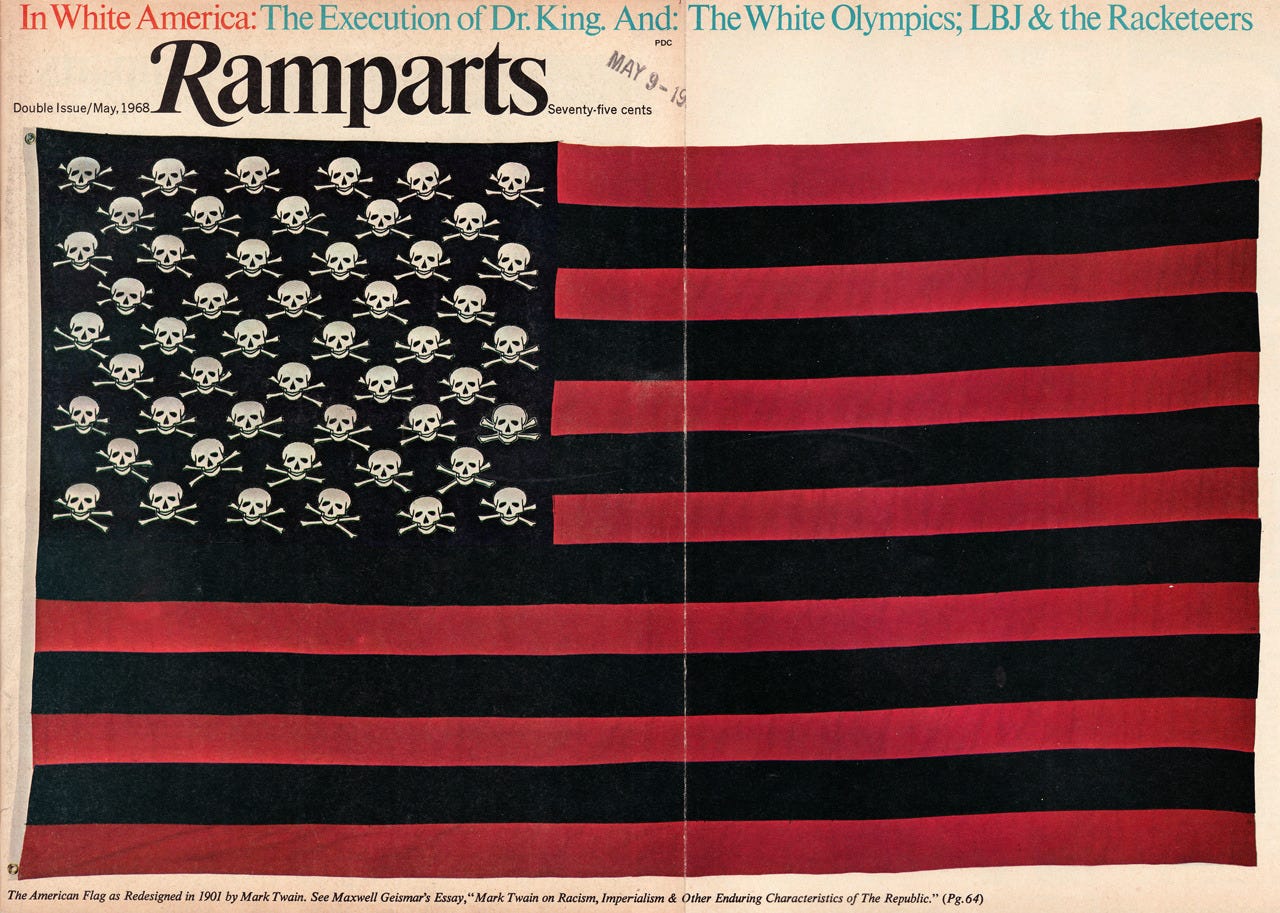
Is the United States really prepared to add skulls and crossbones to the stars and stripes, as Mark Twain suggested in 1901 during the Philippine–American War? And if so, then will most Americans turn to each other and ask, “Are we the baddies?”
Hannah Arendt, Eichmann in Jerusalem: A Report on the Banality of Evil (1964), p. 136.
Arendt, p. 150.
Steven Pinker’s The Better Angels of Our Nature: Why Violence Has Declined (2011), p. 565.
James M. McPherson, Drawn with the Sword: Reflections on the American Civil War (1996), p. 190.
Henry Kissinger, Diplomacy (1994), p. 46.
Kissinger, p. 50.
There are adults that still think in terms of “good guys” and “baddies.”