
Western Civilization Doesn't Belong to the Groypers
The Barbarians Are Within the Gates

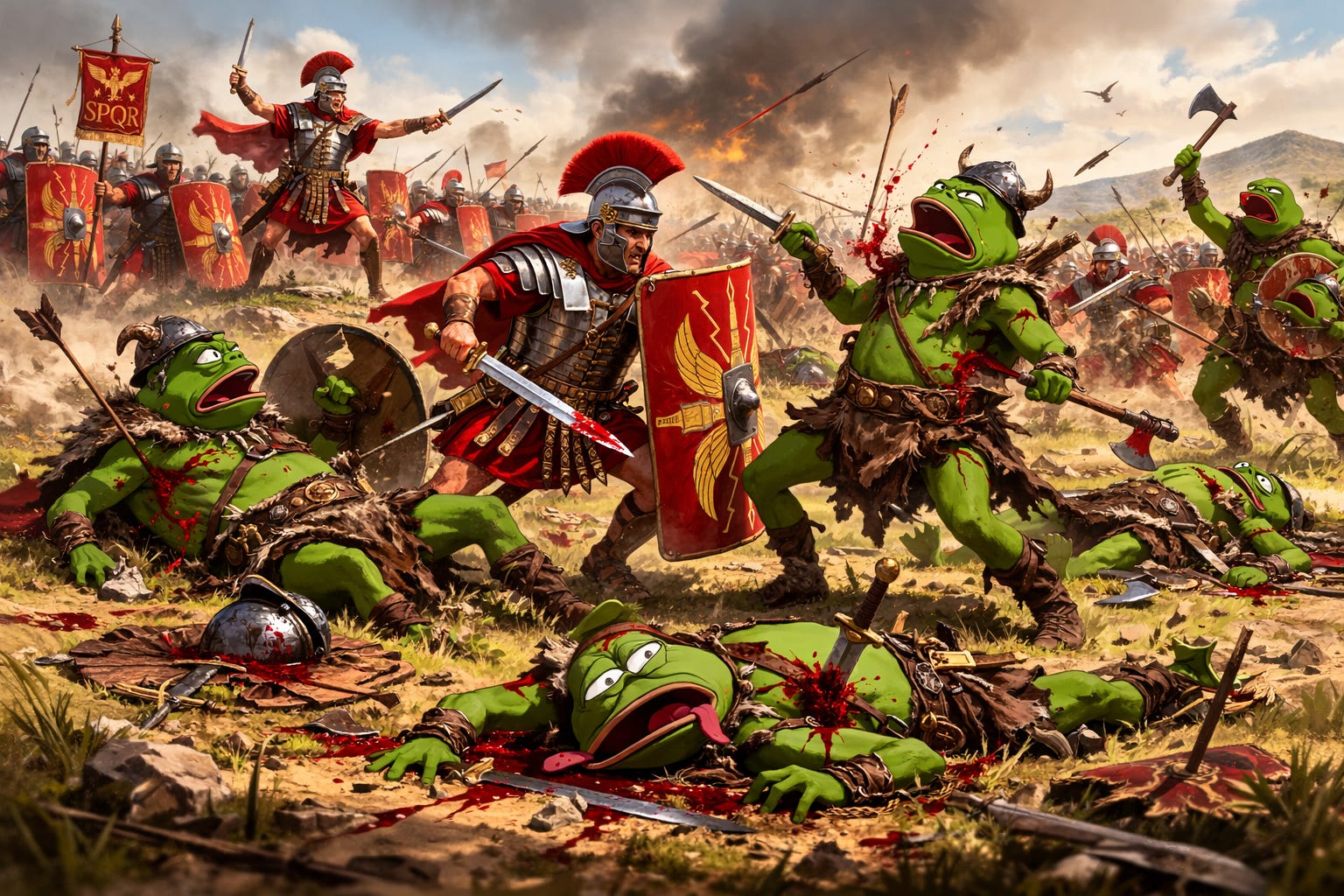
According to Nick Fuentes, Jews “hate the Romans because the Romans destroyed the Temple. . . . We don’t think like that as Americans and white people. We don’t think about the Roman Empire 2000 years ago. They do.”1 As evidence, he cites a photo of Eric Weinstein giving the finger to the Arch of Titus, which celebrates the Roman defeat of Jewish rebels in 73 CE. Fuentes isn’t making a point about historical memory here. The Groyper narrative is that Jews “couldn’t give a fuck about our civilization. They hate Rome. They hate the Catholic Church. They hate the Europeans. They think we have antisemitism in our bones. They hate our ancestors. They don’t care if our country’s flooded with immigrants. . . . As a matter of fact, they want it. It’s their punishment.” In other words, there’s a through line between the supposed Jewish hatred of Rome and the supposed Jewish hatred of Western civilization, as defined by a terminally online incel. In sum, open borders is a thousand-year plot by Jews to enact vengeance on a long-defunct empire. After all, what would make the late Titus Caesar Vespasianus angrier than bringing Venezuelans into the US?
Judea and Rome, Ancient Brothers
Clearly, some Jews do hold grudges against Rome for crushing the Jewish revolts. But against the anecdotal evidence of Eric Weinstein’s bird, I can counter with my own lack of historical antipathy. Yes, the Romans responded to the uprisings with unnecessary brutality, but—no matter how bad some of Judea’s governors were—the Jews shouldn’t have taken on the world’s mightiest empire in the first place. Or, if I’m too marginal a figure to count, how about the great German-Jewish philosopher Leo Strauss? In 1933, just as the Nazis seized power, he wrote rather optimistically, given the circumstances: “I am reading Caesar’s Commentaries with deep understanding, and I think of Virgil’s Tu regere imperio . . . parcere subjectis et debellare superbos [to rule the peoples . . . to spare the conquered and subdue the proud]. There is no reason to crawl to the cross, neither to the cross of liberalism, as long as somewhere in the world there is a glimmer of the spark of Roman thought.” Going further back into late antiquity, the Babylonian sage Rabbah bar bar Hanna praised Pax Romana as compared with Persian rule, saying, “O God, let us live either under Thy protection, or at least under the protection of the children of Esau.”
In Jewish tradition, Rome is identified with Esau, who is Jacob's brother and rival. Esau, in turn, is the forefather of the Edomites, of whom Deuteronomy says, “You shall not abhor an Edomite, for they are your kin.” Thus, from a Torah perspective, it’s actually forbidden to hate the Romans.2 Forbidden to hate, but not to criticize. In the Talmud, Rabbi Yehuda remarks, “How pleasant are the actions of this nation, the Romans, as they established marketplaces, established bridges, and established bathhouses.” To which Rabbi Shimon ben Yoḥai replies, “Everything that they established, they established only for their own purposes. They established marketplaces, to place prostitutes in them; bathhouses, to pamper themselves; and bridges, to collect taxes from all who pass over them.” Still, the fact that the Talmud records both sentiments indicates a certain ambivalence toward Rome. After all, the rabbinic dictum “Pray for the welfare of the government, for were it not for fear of it, people would swallow one another alive,” was written while Rome ruled over Judea. (And Jews absolutely used those bathhouses.) Esau himself is depicted as brutish, but not evil, and ultimately reconciles with his brother Jacob. Accordingly, when Jerusalem is besieged, the rabbinic sages argue for making peace with the Romans, but are overpowered by the Zealots. The Talmud doesn’t even blame the destruction of the Second Temple on Rome, but rather on the Jews’ own sin of baseless hatred toward each other.
It’s also a little ironic that a professed Christian like Fuentes criticizes Jews for opposition to Rome. In the pagan Roman Empire, Jews were exempt from worshipping the Roman gods. Instead, while it still stood, they offered sacrifices to Caesar in the Jerusalem Temple. The Romans sometimes mocked Jewish customs like circumcision and abstention from pork, but respected Judaism for its antiquity. By contrast, the Romans viewed Christians as subversive upstarts who rejected the traditions of their ancestors. As the Neoplatonist philosopher Porphyry argued in Against the Christians, “How can men not be in every way impious and atheistic who have apostatized from the customs of our fathers, through which every nation and city is sustained?” Accordingly, Christians were intermittently fed to the lions until Emperor Constantine converted and then legalized the new religion in 313 CE. Besides Jesus, prominent Christian figures executed by Rome include the saints Paul, Peter, Polycarp, and George. Theologically, no normative Jewish text is as vehemently anti-Roman as the Christian Book of Revelation, which Fuentes putatively claims as his own. While Judaism identifies Rome with Esau, wayward relative of the Jews, John the Revelator depicts the Eternal City as “the whore of Babylon,” a harlot “drunk with the blood of the saints and the blood of the witnesses to Jesus.” Jewish vengefulness can also hardly compare with the church father Tertullian, who lustily anticipates pagans burning in hellfire while the saints enjoy the spectacle.
Another irony: Fuentes refers to the Romans as “our ancestors,” but is of Mexican, Italian, and Irish descent. He can claim some ancestral Romanitas through his Italian side, but neither Ireland nor Mesoamerica was ever part of the Roman Empire. By contrast, Judea was a Roman province or client state for just under 200 years, while Jews have lived in Rome continuously for over 2000 years. Moreover, researchers trace the origins of Ashkenazi Jews primarily to admixture between Judean men and Italian women in the Early Middle Ages, which means that the average non-Mizrahi Jew is at least as ancestrally Roman as Fuentes. Indeed, almost certainly more so, since Judeans themselves were genetically closer to the Romans, a fellow Mediterranean people, than Hibernians or Mesoamericans. Thus, as a proud Ashkenazi Italo-Semite, I have the blood of Caesar flowing through my veins—or, in honor of my Roman foremothers, Lucretia. So, no, Nick, I don’t hate “your” ancestors, because they’re mine.
Liminally Western
Ironically, insofar as some Jews support mass immigration, it’s because they’ve been Westernized, not because they hate Western civilization. Globalist is just a pejorative for cosmopolitan, the Greek term for being a world citizen. In the Hellenistic era, a barbarian could become a Hellene by adopting the Greek language and lifestyle. As the Athenian orator Isocrates remarked in 380 BCE, “our city has left all other people so far behind, that its students have become the teachers of all others, and it has made the name of ‘Greeks’ seem no longer to apply to a race but to a mode of thought.” To help unify his empire, Alexander the Great even arranged mass intermarriage between Greek officers and Persian noblewomen. In the Greek-influenced Roman Empire, citizenship expanded to reflect loyalty and adoption of civic norms, not ethnicity. Notable non-Heritage Romans included the Berber philosopher Apuleius, the Arab emperor Philip the Arab (the name gives it away), and the Jewish radical Saul of Tarsus, later known as Saint Paul. Paul was undoubtedly influenced by Greco-Roman universalism when he declared, “There is neither Jew nor Greek, there is neither slave nor free, there is neither male nor female; for you are all one in Christ Jesus.” (There is also a long tradition of Jewish universalism, but it focuses on reconciling, not merging, different groups.)
Starting in 1492, Western universalism traveled to the New World alongside conquistadores, colonists, and slaves. In 1614, the Reverend Samuel Purchas, one of the first Englishmen to describe the Americas, wrote that “the tawney Moore, blacke Negro, duskie Libyan, ash-coloured Indian, olive-coloured American, should with the whiter European become one sheep-fold . . . without any more distinction of Colour, Nation, Language, Sexe, Condition, all may bee One in him that is One, and onely blessed for ever.” In 1782, French-born writer J. Hector St. John de Crèvecoeur declared that “He is an American, who leaving behind him all his ancient prejudices and manners, receives new ones from the new mode of life he has embraced, the new government he obeys, and the new rank he holds. . . . Here individuals of all nations are melted into a new race of men, whose labors and posterity will one day cause great changes in the world.” Long before the Great Replacement theory, George Washington expressed his hope in 1788 “that this land might become a safe & agreeable Asylum to the virtuous & persecuted part of mankind, to whatever nation they might belong.” In 1801, Thomas Jefferson likewise asked, “And shall we refuse the unhappy fugitives from distress that hospitality which the savages of the wilderness extended to our fathers arriving in this land? Shall oppressed humanity find no asylum on this globe?” If Fuentes is looking for an enemy to blame for America’s openness to immigrants, he should start by looking within.3 Or, to quote a famous rabbi he claims to follow, “You hypocrite, first take the plank out of your own eye, and then you will see clearly to remove the speck from your brother’s eye.“
Of course, the Western tradition doesn’t dictate open borders—or preclude racism— but it clearly supports a naturalization process. How else could the Romans adopt Greek culture and later a Jewish-origin religion? Indeed, how else could Northern Europeans, once considered barbarians, become Western in the first place? Many Jews, to varying degrees, have been naturalized into the West as well. In the Hellenistic era, there’s the philosopher Aristobulus of Paneas, who synthesized Platonism with Torah. In the Roman world, we have Josephus, the Jewish general turned imperial advisor who wrote the history of the Great Jewish Revolt. In the Middle Ages, the rabbi and physician Maimonides was influenced by Aristotelian rationalism (and, in turn, influenced Christian scholastics). Entering modernity, Baruch Spinoza was an early pillar of Europe’s Republic of Letters, while Moses Mendelssohn helped launch the Jews’ own Haskalah (Enlightenment). German Kultur has Heinrich Heine; British statecraft has Benjamin Disraeli; French literature has Marcel Proust. The best guide to the Western canon was written by a Jewish-American literary critic, Harold Bloom, while one of its sharpest modern defenses was written by a Jewish-American philosopher, Alan Bloom. Judaism itself was partly shaped by the West, with the Passover seder inspired by the Greek symposium and rabbinic legal thought paralleling Roman case law. In turn, the modern West was formatively influenced by Jewish ideas like historical teleology and humanity’s divine likeness. Evolutionary biologist Joseph Henrich traces Western individualistic psychology to the Catholic Church’s marriage and family policies, including its ban on polygamy. It’s notable then that, following Christian norms, the Ashkenazi sage Gershom ben Judah banned polygamy in the 11th century CE.
To call Jews collectively Western would be an overstatement. The formative events in the Jewish narrative, as memorialized in the Hebrew Bible, largely preceded Judea’s entry into the Hellenistic world. Significant Jewish communities (including those in Iran, Iraq, and Yemen) lay outside of the West, and the Babylonian Talmud was compiled under Persian rule. Even European Jews were rooted in Near Eastern traditions and, court Jews aside, largely functioned as an outsider caste prior to their gradual emancipation. But the Levant itself is a historically liminal region, a crossroads of trade and cultural exchange. Likewise, Jews as a whole, and the state of Israel in particular (which is only minority Ashkenazi), are liminally Western. We could apply the same description to Lebanon’s Maronite Christians (Francophile Semites) and many Latin Americans (who combine the peripheral Western identity of Iberia with pre-Columbian and African influences). Ukraine qualifies, too, since much of it was under Polish–Lithuanian rule for around four centuries. Thus, the war in Ukraine is taking place along a civilizational fault line between the West and Russia. And Russia itself—while absent from key European developments like the Renaissance and the Enlightenment, and often opposed to the West ideologically—also contains its own historical cleft between Westernizers and Slavophiles.
Pro-White, Anti-Western
Yet to paraphrase his friend Kanye West: Nick Fuentes doesn’t care about Western civilization. If he did, you’d hear him defend Western principles like rational inquiry (pursued by Greek philosophers), the rule of law (rooted in Roman jurisprudence), and individual moral worth (derived from biblical ethics). At the very least, he’d be concerned about the civilizational threats of Chinese totalitarianism and political Islam. But by “our civilization,” Fuentes isn’t referring to a millennia-old inheritance embodied in philosophy, theology, art, and political theory. Instead, “the West,” and Christianity for that matter, functions as a euphemism for white people, selectively defined. (Thus, for Groypers, “Christ is King” is a meme meant to exclude Jews, not an article of faith.) As for rival civilizations, Fuentes has praised China’s dictatorship and literally toasted the Taliban.4 Instead of real civilizational clashes, he’s obsessed with the phantom menace of organized Jewry. Perhaps Fuentes’ call for “Catholic Taliban rule” in America best illustrates how “pro-white” can also be anti-Western. It’s akin to his idol Hitler’s admiration of Islam for being more compatible with the militant Germans than Christianity.
The example of Islam is actually instructive. Islam, like the West, is a multiethnic civilization. It was propagated by Arabs, but not all Muslims are Arabs and not all Arabs are Muslims. Analogously, the West was propagated by white people, but not all white people are Western and not all Westerners are white. Notably, Russia is white but non-Western. Thus, the admiration for Vladimir Putin’s Russia expressed by Tucker Carlson is another example of pro-white but anti-Western sentiment. It’s also ironic, since Russia itself is a multiethnic civilization. Heritage Russians make up only around 72% of the Russian Federation’s population, while Russian ultra-nationalists like Alexander Dugin (an honored Tucker guest) advocate a Eurasian holy war against America and Western Europe. But despite Russia’s imperial ambitions, very few countries wish to join the Russkiy Mir—Ukraine has certainly been resistant. Nor are Communist China or Taliban Afghanistan attracting many imitators. Migrants flock to the West because it’s materially superior—which, in turn, is a function of institutionalized norms, historically rooted values, and WEIRD psychology. When newcomers don’t adapt, Western societies risk becoming like the countries they left behind. Yet the solution to mass migration isn’t to abandon what makes the West attractive in the first place.
Unlike Islamic civilization, the West isn’t strictly defined by religion, though Christianity has been foundational. When Fuentes says that Jews have no place in Western civilization because they aren’t Christian, he’s begging a number of questions. Were “virtuous pagans” like Socrates and Virgil part of Western civilization? How about deists like Voltaire and Thomas Jefferson? Or agnostics like Charles Darwin and atheists like Friedrich Nietzsche? According to recent surveys, just over 60% of Americans identify as Christian. Are the remainder (most of whom don’t belong to any other religion) non-Western? What about African Christians? Are they Western by virtue of their Christianity? Fuentes would clearly answer no to this last question, which reinforces the point that his Christianity is just window dressing for white tribalism. As much as Christianity is tied to the West, so is freedom of conscience and religion. Indeed, Jesus’ own statement that we should “Render therefore unto Caesar the things which are Caesar’s, and unto God the things that are God’s” points in this direction. After the Wars of Religion devastated Europe, the 1648 Peace of Westphalia normalized toleration. The American Founding, which enshrined religious liberty as a civil right, was the fruition of an ancient (if contested) trend in Western history. Does it apply only to Christians? Washington certainly didn’t think so, writing in his 1790 letter to the Hebrew Congregation in Newport, Rhode Island, that the United States government “gives to bigotry no sanction, to persecution no assistance.” Fuentes would call him a cuck.
Even if I weren’t part Roman myself, I’d respect Europeans as the Arabs of the West. But at the same time, just as Turks can submit to the will of Allah as well as any Bedouin, so too can non-white Westerners commune with the immortal works of Shakespeare, Michelangelo, and Bach. In the American context, a swarthy immigrant like me can count the Founding Fathers as his ancestors, just as European Christians consider a Jew to be their messiah. After all, as the Roman playwright Terence once wrote, “I am human, nothing human is alien to me.” That being said, the West is no longer self-confident, classically grounded, and sure of its civilizing mission. A spiritually weakened civilization is less able to absorb foreigners, especially at scale, or even to articulate integration rather than asymmetrical multiculturalism as a goal. Long before anyone heard of “woke,” it was academically fashionable to dismiss Western thinkers as “dead white men”; to deconstruct, decolonize, and problematize the canon. Drawing on activist scholarship, DEI programs then applied the same contemptuous attitude toward living white men and meritocratic institutions. Radical Third Worldists, including future New York congresswoman Darializa Avila Chevalier, literally call themselves “Westerners fighting for the total eradication of Western civilization.” Thus the pro-white, anti-Western right is in a destructive dialectic with the anti-white, anti-Western left. Groypers even accept the basic premise of critical race theory—that Western values are a mask for white supremacy—but propose that we simply drop the facade. Today’s barbarians are within the gates, and they’re coming from both sides.
I owe this insight to Emmanuel Levinas, who makes the lesson for modern Jews explicit: “Israel cannot forget the verse Deuteronomy 23:8. The West is Israel’s brother.”
At least Fuentes’ alt-right predecessor Richard Spencer was honest about the anti-American implications of Nazi simping: “America as it is currently constituted—and I don’t just mean the government; I mean America as constituted spiritually and ideologically—is the fundamental problem.”
See also Tucker Carlson’s praise of sharia law.
Jews at the time of the Talmud weren’t not anti-Roman, they just weren’t particularly anti-Roman. The interactions between the Jews and the Empire sparked the most famous anti-gentile sentiments in the Talmud that are often repeated by people like NJF. On the other hand, Romans deported Jews from the city of Rome multiple times and had basically nothing good to say about them or their religion, and the Romans engaged in what can only be described as genocidal campaigns against Jewish populations during the second and third Jewish-Roman wars. The only nations the Romans devastated at any similar level was the Carthaginians and maybe the Gauls if we are to believe Caesar word for word. While it is true that Jews descend mostly from a population resembling urban Imperial Romans, virtually no Jews identify with this ancestry and most don’t even know about it. The connection between Rome and Esau might not be a result of direct interaction with Romans, but from interaction with Rome’s Idumean clients who were actually the descendants of the biblical Edomites in the early days of Roman influence over Judea.
The claim that the Greeks were “civic nationalists” is much more ridiculous than any of the above, though. Athenian citizenship was passed down through both the mother and the father, so a half-breed could not become a citizen. Aristotle, Alexander’s Greek master, was one of History’s first “race realists” and both he and most of Alexander’s generals disapproved of the intermarriage policy. After Alexander’s death, most of the Diadochi divorced their foreign wives, and some Greek kingdoms in the east developed a sort of ethnic hierarchy with Greeks above both ordinary locals and Hellenized locals. Irregardless, Alexander’s forced marriages have nothing to do with what you’re talking about. He wasn’t Hellenizing the Persians, he was in many ways Persianizing his own generals for the approval of local satraps! Alexander himself began waltzing around in Persian garb, and of course married the Sogdian Roxanne.
There were civic nationalists among the Romans, but other Romans viewed Roman ethnicity as blood-based, hence why the Romans often tried to slander each other by claiming another had barbarian ancestry. Augustus Caesar was accused of having African ancestry, and in turn Augustus spoke at length about the concern of Roman blood being replaced by barbarian blood.
Your evidence of naturalization being “western” is a handful of quotes from a few American founders who elsewhere expressed or enacted policy that ensured American citizenship be limited to ethnic Europeans, which was the undisputed reality of this country until after the Civil War, and even thereafter the only exception was towards Black African slaves until 1952. The European barbarians did not “become” Western, the West was a synthesis of characteristics from both Northern and Southern Europe that formed only around the late medieval period.
>How about deists like Voltaire and Thomas Jefferson
No, we do not want them.