
Third Worldism's Inevitable Blowback
Adversarial Assimilation Is Its Own Worst Enemy

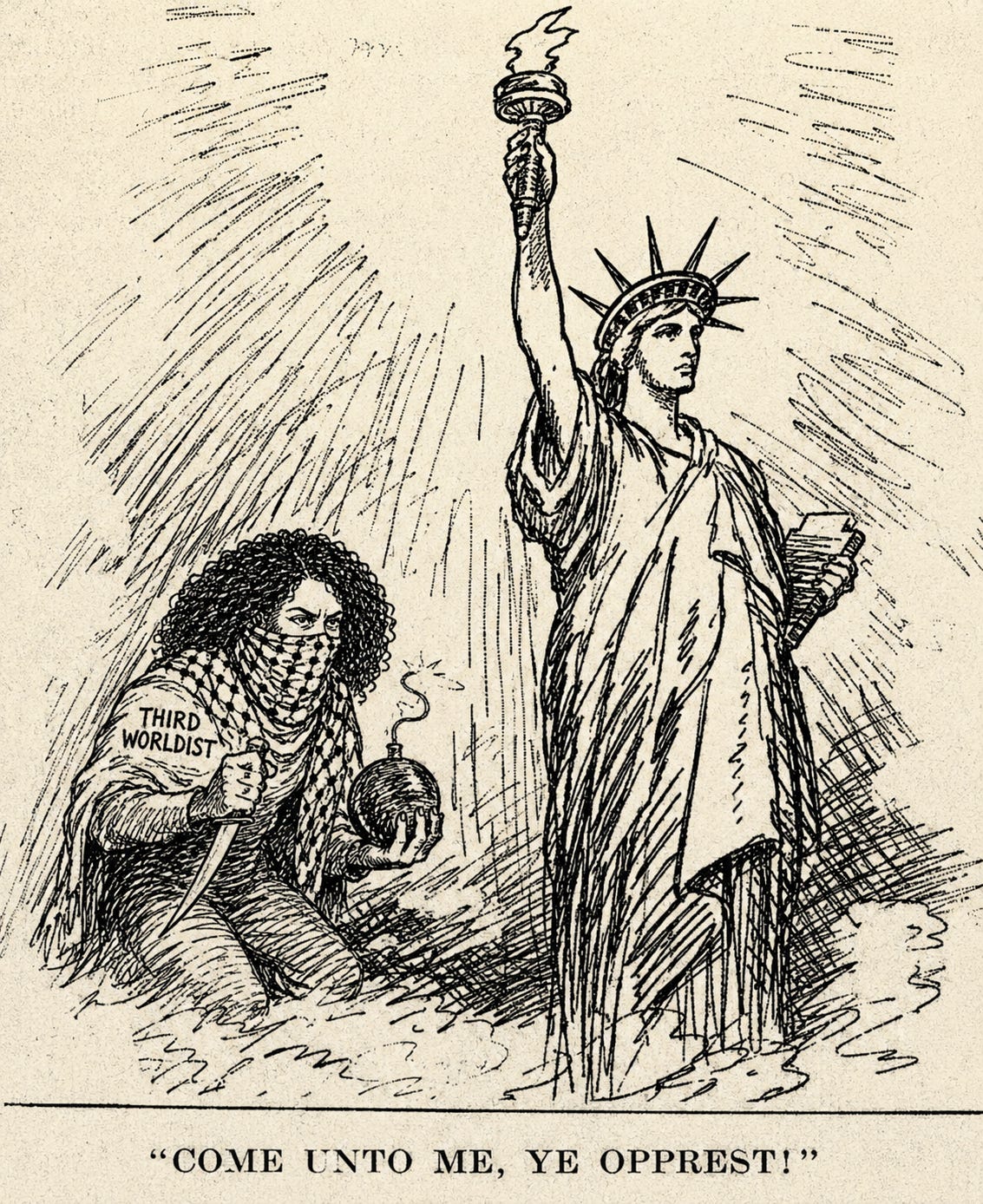

Melat Kiros, an Ethiopian-born Democratic Socialist congressional candidate, called the 9/11 attacks “inevitable.” Hasan Piker, the Turkish-American livestreamer and Mao fan, went further, saying “America deserved 9/11.” Another Democratic Socialist congressional candidate, Darializa Avila Chevalier, is a Dominican-American who supports communism and co-founded Columbia University Apartheid Divest (CUAD), which described itself as “Westerners fighting for the total eradication of Western civilization.” Kiros, Piker, and Chevalier are clear examples of what political scientist Robert Leiken called “anti-West westernization” or “adversarial assimilation.” Reihan Salam defines this as “a process by which incorporation into American institutions produces not attachment to patriotic narratives of American freedom, individualism, and benevolence but hostility toward them.” The term “assimilation” is important here. Kiros, Piker, and Chevalier all attended top American schools. They criticize the West using a Western language of social justice, settler-colonial theory, and Marxism. Yet adversarially assimilated immigrants also retain and magnify the anti-Western grievances and rival civilizational loyalties of their home countries. Notably, as Salam writes, “For a subset of younger American Muslims, the faith has become less a set of devotional practices than an emblem of resistance to Westernness and whiteness.” Consider how Chevalier converted to Islam but continued to praise communist atheists like Fidel Castro and Kim Il Sung. Michel Foucault, the postmodern philosopher who admired the Iranian Revolution, would see no contradiction in the “political spirituality” of her Islamo-leftism.
Yet for most of its adherents, Islamo-leftism is less an ideological synthesis than an anti-Western alliance brought together by shared grievances. Foucault himself was gay, and so an early precursor of the “Queers for Palestine” whose sexuality would get them executed by Hamas. Thus Salam disambiguates Islamism and Third Worldism, which he notes “are distinct in their character, different in their dangers, and yet mutually reinforcing.” Islamism is the more immediate threat because it directly inspires jihadist violence. But Third Worldism is the bigger long-term challenge, because its appeal doesn’t rest on what remains, in the West, a minority religion. You don’t need to be Muslim to be a Third Worldist, although, as the Chevalier example demonstrates, conversion is a natural pathway for the most zealous ideologues.1 Instead, you just need to accept a binary division of the world into the oppressors and the oppressed, the settlers and the indigenous, the colonizers and the colonized. In this Manichaean worldview, Westerners and white people are structurally oppressors, settlers, and colonists. Third Worlders and BIPOCs are intrinsically oppressed, indigenous, and colonized. Third Worldism reinforces Islamism because it valorizes anti-Western violence as liberatory, or, per Kiros, excuses it as “inevitable.” It’s no coincidence that the Venn diagram between supporters of 9/11 and October 7 overlaps so heavily. As Zineb Riboua writes, “In the Third-Worldist imagination, America is the final imperial actor and Israel its most visible extension. Hostility toward Israel becomes a socially acceptable proxy for hostility toward American identity, institutions, and global leadership.”
The appeal of Third Worldism to erstwhile Third Worlders is obvious. They get to experience the benefits of the West—including material prosperity and personal freedom—while also self-righteously castigating it from a morally privileged position. But in so doing, they violate the implicit social contract that made their immigration to the West possible. Salam notes that “many young American Muslims have rejected the quiet gratitude that one associates with immigrants and their children of earlier eras.” But this quiet gratitude, coupled with what John Fonte of the Hudson Institute calls “patriotic assimilation,” helps make immigration politically palatable. As Fonte defines it, patriotic assimilation is when “immigrants essentially adopt American civic values and the American heritage as their own” and “begin to think of American history as ‘our’ history not ‘their’ history.” If, instead, a critical mass of immigrants undergo adversarial assimilation, then the still-patriotic majority of Americans—including many other immigrants and children of immigrants—may feel they’re being replaced rather than joined. Even with patriotic assimilation, immigration at a large enough scale is likely to induce feelings of cultural erosion. So when Chevalier tweets “I forgot to get napkins so I just wiped my hand on the American flag behind me,” and Piker says “I don’t have any sort of patriotism in my heart for America” in a livestream from Beijing, they’re unwittingly making the case for immigration restrictionism.
On the 250th birthday of the United States, New York City’s Indo-Ugandan-American mayor, Zohran Mamdani, delivered a grievance-laden speech from George Washington’s desk, surrounded by newly naturalized citizens. He noted, correctly, that “patriotism has never been about pretending our nation is without flaws.” Yes, but it is about putting those flaws in their proper perspective. Traditionally, immigrants held that proper perspective because they had direct experience of the demonstrably worse countries they fled. There are no more ardent opponents of communism than the Cuban-Americans who once lived under its boot. By contrast, a Washington Post profile notes that for Somali-born Minnesota congresswoman Ilhan Omar, “America wasn’t the bighearted country that saved her from a brutal war and a bleak refugee camp. It wasn’t a meritocracy that helped her attend college or vaulted her into Congress. Instead, it was the country that had failed to live up to its founding ideals, a place that had disappointed her and so many immigrants, refugees and minorities like her.” A patriot would agree that America has sometimes failed to live up to its founding ideals. But she would add that her native Somalia lacks any such founding ideals at all, not to mention a functioning government. Omar’s absence of proper perspective is typical of Third Worldism, which only acknowledges non-Western deficiencies if they can be blamed on Western crimes. But instead of apologizing for disappointing her, the average American is liable to wonder if Omar wouldn’t be happier in Mogadishu, where violent anarchy is a small price to pay for the absence of Islamophobia.
Don’t immigrant Americans have the right to castigate their new country? Isn’t demanding of them “quiet gratitude” the imposition of two-tier citizenship, in which only “Heritage Americans” have freedom of speech? Yes, per the US Constitution, Melat Kiros has the right to call 9/11 inevitable. But the Diversity Visa Lottery through which she arrived in the US isn’t enshrined in the Constitution. It was established by Congress in 1990 and, given sufficient backlash, could just as easily be abolished. My point is that, if basic decency doesn’t suffice, Third Worldist immigrants should at least avoid calling themselves “Westerners fighting for the total eradication of Western civilization” for the sake of their own pro-immigration politics.2 (And, if they’re not naturalized citizens, for the sake of their own immigration status.) Americans have the right to freedom of speech, but they also have the right to decide who enters their country and becomes an American. DSA delusions aside, communism combined with unrestricted mass immigration isn’t a popular political position. True, Third Worldists have scored a number of recent electoral victories, which indicates that they’re not just a terminally online fringe, but they remain vastly outnumbered by First Worldists. For First Worldists, the West is successful because of superior institutions and values, not exploitation; flying planes into buildings is a depraved moral choice, not an inevitability; and communism is a failed ideology for losers and sociology PhDs (but I repeat myself). Many immigrants to the West are themselves First Worldists who are proud to have left the Third World behind. But for all their advocacy of open borders, the most likely, if inadvertent, policy accomplishment of Third Worldism will be the curtailing of Third World immigration. If I could bear to be so smug and condescending, I might even borrow a term from Kiros and say it’s inevitable. Or that Hasan Piker deserves it.
To quote CUAD:
not only is Islam not a problem, but it offers in its ethically rooted and counter-hegemonic traditions, a potent critique of the horror-scape that has been produced by late-liberal capitalist/colonial modernity: of environmental superexploitation, insatiable capitalist predation, neoliberal forms of governmentality, alienation, surveillance and repression, displacement and forced migration, forever wars, neofascistic death cults like Zionism, and in liberal modernity’s ultimate form, the practice of genocide, or total death of the Other.
How could a Democratic Socialist resist a pitch like that?
When should you call yourself “Westerners fighting for the total eradication of Western civilization” then? Preferably never. But if you insist on hating your own country and civilization, at least wait until you’re a third-generation immigrant. By that point, the rejoinder “Love it or leave it” is unfair, since you don’t have another country to easily go back to. By contrast, for example, children born abroad to Turkish citizens automatically acquire Turkish citizenship, so New Jersey native Hasan Piker could easily decamp to Istanbul if America so upsets him.
Our Anti-Western academy, especially the highest ivy-covered rungs, works as a permanent shadow government or more like a permanent prosecution, positing their socialist egalitarian idealism as the moral credential that provides both their right to rule but also their right to unlimited government funding—yet lately I've also been seeing it as one of the harbingers of our gradual transition from American republic to American Empire.
Under the American Empire, our most prestigious institutions are doing what they've always done: preparing the next leaders of the country and also installing in them the proper mandatory ideology of the future ruling class. In this case the Empire is formed as the opposite and enemy of the Republic: it despises its Founding heroes and histories, disparages its accomplishments and pronounces its illegitimacy, creates new founding principles meant to erase the old ones ("Diversity" vs E Pluribus Unum etc) essentially condemns it to death for its crimes against the imagined egalitarian future and seeks to deliver its sentence.
Thus the Empire's future ruling class is born and formed: global instead of American, as opposite as possible from the Protestant European men who created the country, suspicious of all inherited ties (if they're Western), promising to install a top-down managed govt of commissars and apparatchiks blessed with the proper degrees and "critical consciousness", essentially becoming both post-Christian and hyper-Christian by starting every day with a prayer for the Wretched of the Earth.
The Empire's future globalist ruling class is held together by ideology and status, not by national or religious ties or anything as gauche as blood-and-soil lineage. Right now they're in the process of killing off the old Republic so their Empire can be born, but this is as easy now as chopping down a dead tree. The termites of civilization that are the Critical Theorists have already done their work, our walls and foundation are long since rotted and will collapse sometime in the near future when heavy pressure (whether war or depression or some other cataclysm) is applied.
Hope that makes sense!
Kind of a racist screed dude 😡🤮