
The Postwar Consensus Was Based
Bring on the Woke Scare


According to a prominent “dissident right” narrative, the decline of the West can be traced to the “postwar consensus.” In his 2019 book Return of the Strong Gods: Nationalism, Populism, and the Future of the West, R. R. Reno defines the term as follows:
The violence that traumatized the West between 1914 and 1945 evoked a powerful, American-led response that was anti-fascist, anti-totalitarian, anti-colonialist, anti-imperialist, and anti-racist. These anti-imperatives define the postwar era. Their aim is to dissolve the strong beliefs and powerful loyalties thought to have fueled the conflicts that convulsed the twentieth century.
The postwar consensus narrative takes two distinct forms. In the moderate interpretation, what Reno calls the “strong gods” of faith, family, and nation have been wrongly impugned as fascist. In that vein, Renaud Camus, the French originator of the Great Replacement theory, refers to the “second career of Adolf Hitler.” He argues that the Führer has been employed to prohibit “not only all reference to races, it goes without saying, but also to one degree or another all reference to ethnicities, peoples, civilizations, diverse cultures, origins in general, and nations in their temporal aspect, that is, their heritage, transmission, and survival.” But Camus also writes that “This role as the absolute embodiment of Evil was certainly not ill-deserved; no one was better qualified to play it than he.” In other words, Nazi evil has been unfairly deployed to tarnish what is not evil, like national identity tout court.
The second, more radical interpretation goes further: Nazism itself has been unfairly tarnished as evil. Historical revisionist Darryl Cooper, who was sympathetically interviewed by Tucker Carlson, agrees with the moderates that “The post–World War II order is really defined by the fact that, you know, after Nuremberg, it really became effectively illegal in the West to be, like, genuinely right wing, like the things we call right wing.” But he rejects Camus’ judgment that Hitler’s demonization was well-deserved. Instead, he argues that Winston Churchill, not Hitler, “was the chief villain of World War II.” In turn, Cooper presents a more moderate (or perhaps merely crypto-Nazi) face than influencer Nick Fuentes, who flat-out says that “Hitler was cool.” So, how bad was the postwar consensus for a Nazi victory in World War II to be preferable? Did it really prohibit being “like, genuinely right wing,” or paying fealty to the “strong gods” of faith, family, and nation?
On the contrary, by right-wing standards, I’d say the postwar consensus was actually pretty based, and we need an updated version for our time. Here’s why.
The Real Postwar Consensus: Better Dead than Red
Reno leaves out one very important “anti” from his list of postwar imperatives: anti-communism. In terms of actual politics, anti-communism was a much more defining feature of the postwar consensus than anti-fascism, anti-colonialism, anti-imperialism, or anti-racism. Reno does mention anti-totalitarianism, but there was no right-wing totalitarian country following the defeat of the Axis powers in 1945. Thus, postwar critiques of totalitarianism were primarily aimed at the Soviet Union and the Eastern Bloc.1 The Truman administration enacted the 1947 Marshall Plan to fund the recovery of war-torn Europe in order to prevent its fall to communism. Likewise, NATO was formed in 1949 as a defensive alliance against the Soviets in Europe. But you wouldn’t know that by reading an article on the postwar consensus in American Reformer. Here we read, bizarrely, that the Marshall Plan “provided conditional aid ($13 billion) to rebuild Europe according to world unification [?] goals.” Likewise, NATO’s aims are anachronistically listed as “to beat back the conflict-ridden ‘jungle’ of a multipolar world where world war once again becomes possible, to ensure perpetual peace, to police rogue nations and protect human rights, and to enforce international law.” That would be news to President Dwight Eisenhower, who declared in 1959 that its purpose was “to protect the spiritual foundations of Western civilization against every kind of ruthless aggression,” most notably “the forces of atheistic materialism and coercion.” Sounds pretty based.
We know that, during the Cold War, anti-communism trumped anti-fascism, anti-imperialism, and anti-racism, because America backed countries that fit all three labels. Spain’s Francisco Franco received support from Hitler and Mussolini during the Spanish Civil War. Nevertheless, per the 1953 Pact of Madrid, authoritarian Spain entered into a bilateral security partnership with the US. Likewise, Portugal’s António de Oliveira Salazar ran a Catholic corporatist regime, but was still welcomed as a founding member of NATO. Portugal—like fellow NATO members Britain, France, Belgium, and the Netherlands—also joined NATO while still maintaining an overseas empire. France fought a bloody war to keep Algeria until withdrawing in 1962, but Portugal only relinquished its last African possessions in 1975.2 As for racism, apartheid South Africa collaborated with the West to fight Cuban and Soviet-backed guerrillas in Angola during the 1970s. In its own hemisphere, the US encouraged the 1973 coup that replaced Chile’s Marxist president Salvador Allende with right-wing dictator General Augusto Pinochet. Strange move for a superpower supposedly driven by instinctual anti-fascism. Other better-dead-than-red pilled Cold War allies included Greece’s colonels’ junta, Iran’s Shah Mohammad Reza Pahlavi, and Nicaragua’s Anastasio Somoza García (FDR, apocryphally: “Somoza may be a son of a bitch, but he’s our son of a bitch”).3 America also employed literal ex-Nazis in its service, notably rocket scientist Wernher von Braun.
America’s postwar consensus, affirmed by Republicans and Democrats (at least the Cold War liberals among them) alike, held that right-wing authoritarianism was better than left-wing totalitarianism, though neither was ideal. The only Cold War president to buck the trend was Jimmy Carter, whose moralizing and indecision contributed to the downfall of the Shah in 1979. As it turns out, America’s postwar consensus was largely correct, since the Shah was replaced by a much worse regime: the Islamic Republic of Iran. (Communists contributed to the Iranian Revolution, but were then crushed by the Islamists.) Compare also Park Chung-hee’s economically ascending, authoritarian South Korea with Kim Il-sung’s impoverished, totalitarian North Korea, or Emperor Haile Selassie’s autocratic but modernizing Ethiopia with the Derg regime that deposed him and then triggered famine and economic collapse. In many such cases, American-backed strongmen were better both for the United States geopolitically and their own people internally. Dopey accounts of postwar idealism can’t account for the often-brutal Realpolitik that helped America win the Cold War. As that master practitioner Henry Kissinger put it, “The Soviet empire failed in part because its own history had tempted it inexorably toward overextension,” while its leaders overestimated their decrepit system’s “ability to consolidate its gains, both militarily and economically.” In response, America’s Cold Warriors “were determined to resist the Soviet geopolitical offensive and considered history to be on the side of the democracies.”4 They were proven right, and their confrontational approach (balanced by tactical detente) helped drive the USSR into retreat and eventual collapse.
Compare the anti-communist records of America and Nazi Germany. The Nazis first signed a pact with Stalin, consigning the Baltic states, half of Poland, and parts of Romania and Finland to Soviet domination. They then waged a catastrophic war based on Hitler’s strategic blindness (on the USSR: “We have only to kick in the door and the whole rotten structure will come crashing down”) and tactical stupidity (which prioritized winning Lebensraum over seizing Moscow), intertwined with a fanatical anti-Slavism that alienated potential allies. (Not to mention the self-destructive nature of Nazi antisemitism, which prioritized killing Jews over winning the war.) As a result of the Nazis’ world-historical failure, the USSR ended up occupying half of Europe, including much of Germany itself. Communists were also able to burnish their reputations through anti-fascist rhetoric, since the Nazis were the only regime with a comparably mass-murderous record, while military victory buttressed their triumphalist narrative.5 As Raymond Aron wrote in the 1950s, while belief in Bolshevism’s historical mission might have seemed “strange in 1917” and “dubious in 1939,” it had since “been sanctified by the god of battles.”6 By contrast with the Bolshevik-boosting Nazis, America and its allies utterly defeated the Soviet Union and largely discredited communism while averting the apocalypse of another world war. And while Nazi Germany, a so-called nationalist power, sought to destroy other nations in the name of racial globalism, the US helped liberate captive nations from global communism. America’s hubris after the Cold War shouldn’t blind us to the magnificence of its earlier victory.
Regaining Our Cold War Mojo
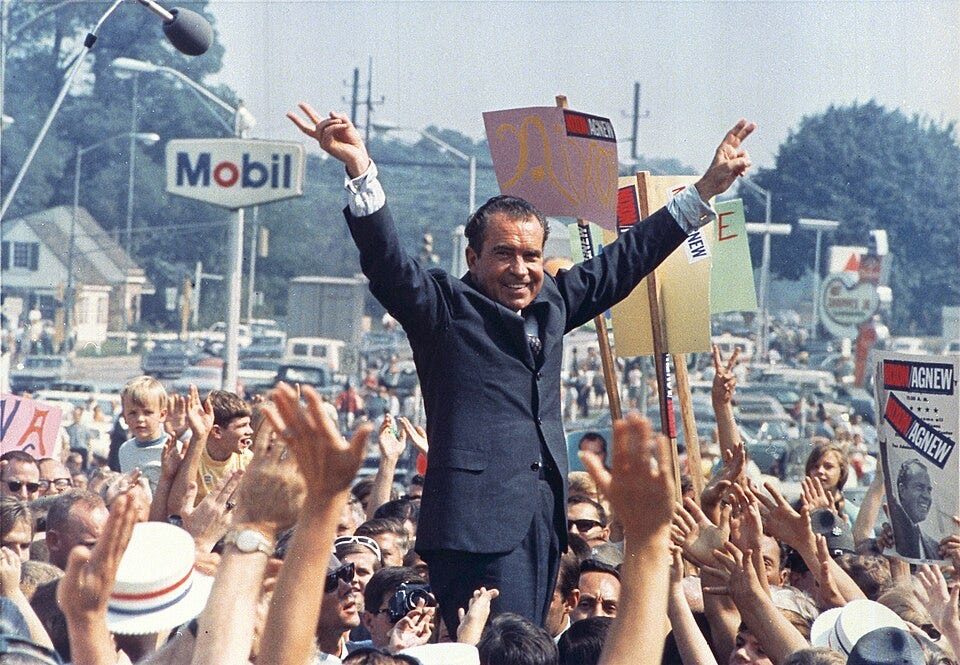
What about the postwar consensus at home? Was America backing authoritarian chads abroad while mandating men in women’s sports at home? Far from it. As Noah Smith writes, “the postwar decades in America saw the greatest surge in church attendance, civic participation, family formation, and social solidarity since the early days of the Republic. . . . The Greatest Generation believed with all their hearts that Hitler was Satan on Earth. But they did not believe that family, community, and tradition were little Hitlers that needed to be crushed in order to uphold the open society.” Yet the Greatest Generation was succeeded by the baby boomers, many of whom indeed questioned faith in traditional authorities. Steven Pinker describes a “decivilizing process” in the 1960s that was largely generational, with three primary targets in the counterculture's crosshairs: self-control, devalued in favor of spontaneity (“If it feels good, do it”); embeddedness in webs of community and obligation, derided as “selling out to the man”; and family life, denigrated in favor of the “free love” now abetted by the birth-control pill.7 But hippiedom was never a societal consensus, and most baby boomers eventually grew out of their coming-of-age excesses. Even at the time, the “silent majority” supported Nixon’s 1968 presidential victory and landslide 1972 reelection. America wasn’t just wracked by anti–Vietnam War protests in 1969; it also put a man on the moon. Still, if you’re looking to trace a modern revolt against faith, family, and nation, the mid-1960s are a better starting point than the postwar era as a whole.
But even here, the right tends toward monocausal or conspiratorial explanations for overdetermined social changes. Notably, Theodor Adorno and the Frankfurt School (“cultural Marxism”) are often blamed for the rise of the counterculture. But Pinker points to a number of more salient structural factors, including the baby boomers’ demographic heft (immortalized in the Doors’ song “Five to One”8), new technology that helped create a common youth culture (TV, the transistor radio), and political developments that called institutions and norms into question (notably the Vietnam War, the civil rights movement, and Watergate). Academic radicalism was part of the mix, but a rock n’ roll-hating, suit-and-tie-wearing square like Adorno was much less influential than countercultural bard John Lennon (whose “Imagine” is a virtual communist anthem) or psychedelic guru Timothy Leary. The median hippie pored over Jack Kerouac’s On the Road, not Herbert Marcuse’s One-Dimensional Man: Studies in the Ideology of Advanced Industrial Society. And let’s not forget the prefix “counter.” As recently as the early 1990s, over 90% of American adults identified as Christian. Until 2015, over half of US adults were married. And until 2018, fewer than 10% of American adults consistently reported having little or no national pride. Right-wing doomers are correct that support for faith, family, and nation have been declining in the US, but the timeline doesn’t support the postwar consensus as the root cause. Rather, from a conservative perspective, America would be lucky to regain some of its Cold War mojo.
The Post-Woke Consensus
In part, America was a more cohesive society in the 20th century because of a shared common enemy: totalitarianism. First the Nazis, then the Soviets, were a perfect foil for America’s socio-political ideal of gun-toting freedom. Notably, the label “totalitarian” recognized enemies on both the right and the left. Yes, many normie right-wingers have been unfairly tarred as fascists. But on the other hand, normie left-wingers have also been unjustly smeared as communists. That doesn’t mean we should rehabilitate fascism or communism in response. When I filled out my American citizenship application in 2024, I was asked, “Have you EVER been a member of, involved in, or in any way associated with any Communist or totalitarian party anywhere in the world?” (I answered no.) Also, per US Citizenship and Immigration Services, “Applicants who were affiliated with the Nazi government of Germany or any government occupied by or allied with the Nazi government of Germany, either directly or indirectly, are ineligible for admission into the United States and permanently barred from naturalization.” I rather like belonging to a country that bars communists and Nazis from naturalization. I’d extend the definition of “totalitarian” to explicitly include Islamist groups like the Muslim Brotherhood, and enjoy being able to exercise my democratic right to make that case.
But though there are still totalitarian regimes (eg, North Korea) and movements (eg, the Islamic State), none poses as much of a threat to the free world as the Nazis and the Soviets. (I reject the argument you sometimes hear from the right that liberalism or rule by the “managerial elite” is totalitarian. This is as much a distortion of language as the use of “fascism” to describe run-of-the-mill nationalism.9) Thus, we can’t build a common politics out of anti-communism and anti-Nazism anymore. However, a new term has emerged to capture the current state of horseshoe-shaped politics: woke. The woke left see themselves as awake to the structural racism, sexism, and cisheteronormativity that lead to systemic injustices against people of color, women, and gender nonconformists. Analogously, the woke right consider themselves awake to the deep state, cultural Marxism, or simply “organized Jewry,” which they blame for systemic injustices against white Christian men. Thus, wokeness is not simply social liberalism or even identity politics more broadly. What’s woke is to blame personal and/or group failings on a de facto conspiracy, to reject institutional neutrality as a false ideal that serves the conspiracy, and to build a political tribe around resentment rather than agency. In an earlier era, these would rightly be deemed un-American activities.
Donald Trump’s second presidency and the accompanying vibe shift drove the woke left into at least a temporary retreat. But a woke right, equally contemptuous of the American tradition, has gained new influence. And like the Soviet and Nazi sympathizers of the 20th century, today’s subversives—whether rightoid Russophiles or progressive Third Worldists—genuflect before hostile foreign powers. When New York City mayor Zohran Mamdani refers to “the warmth of collectivism” and Tucker Carlson hosts Hitler fans on his podcast, we know that the anti-totalitarian spirit is due for a revival. The postwar consensus, properly understood, wasn’t a conspiracy against traditional values. It was the political and cultural inheritance of a society that defeated totalitarianism and, however imperfectly, built something better. At its best, the postwar era recognized the strong gods of faith, family, and nation, while at the same time upholding the rule of law, individual liberty, and civil society as guardrails against idolatry. The post-woke consensus should learn from America’s end-of-history hubris and countercultural excesses. But it should also reclaim the based self-confidence in civilizational greatness that helped save the West twice over. And it should rally against the enemies, both domestic and external, who seek to destroy it once again.
Leftists opposed to anti-totalitarianism (ie, de facto totalitarian sympathizers) have made precisely this point. For example, scholar Enzo Traverso says that the golden age of the term totalitarianism “was the first step of the Cold War, when it became instrumental in denouncing the USSR as the enemy of the ‘free world.’”
The US often opposed imperialism rhetorically, but this stance was largely strategic. Washington was competing with the Soviets for global influence, and European imperialism was, not surprisingly, unpopular outside of Europe. Anti-communism, far more than principle, was the driving impetus behind American anti-imperialism. In practice, America actually backed imperial rule when it served broader strategic interests. For example, the US supported France’s attempt to reassert colonial control in Indochina, then inherited its mess after the French withdrew. Those who blame American hegemony for Europe's diminished place in the world have the causation backward. The continent was mortally weakened not by the US, or even the Soviet Union, but by two self-inflicted world wars.
For a more comprehensive list, see the 1989 Friendly Dictators trading card set.
Henry Kissinger, Diplomacy (1994), pp. 763–4, 766.
We can endlessly debate whether Hitler’s Germany or Stalin’s USSR was “worse.” Eminent Sovietologist Robert Conquest makes a strong case thusly: “Asked why he, the great anatomizer and accuser of Stalinism, still regards Nazism as morally worse than the Gulag, he replies mildly but somehow irrefutably, ‘I simply feel it to be so.’”
Raymond Aron, The Opium of the Intellectuals (1955; trans. 1957), p. 113–4.
Steven Pinker, The Better Angels of Our Nature: Why Violence Has Declined (2011), pp. 110-112.
Nothing in Adorno and Horkheimer’s Dialectic of Enlightenment (1947) is as persuasive as Jim Morrison’s refrain:
The old get old
And the young get stronger
May take a week
And it may take longer
They got the guns
Well, but we got the numbers
Gonna win, yeah
We're takin' over
Come on!
Tellingly, radical leftists make almost the exact same horseshoe-shaped argument. See Traverso, cited above: “Paradoxically, a new form of neoliberal totalitarianism is coming into being, dressed in anti-totalitarian clothes (market and individualism as symbols of freedom against racial and class collectivism).”
The Post War consensus wasn't 'based'.
Nixon basically suffered the first ever media coup for some of his operatives being in a hotel that was notorious for dirty Democrat deeds (the whole Watergate story is BS - funny, much like most of the official story around WW2). So Nixon isn't viewed by anyone outside the dissident right as 'based' - he is reviled.
Darryl Cooper is right about Churchill and WW2. The facts say so, not the hubristic post war regime narrative that really only benefits Zionist at this stage in the game and is destroying the West as we speak today.
It is interesting to see you so confused about ‘nationalism’ all the time.
Socialists claim only they can truly beat the fascists. If anything it's the opposite. Only the prospect of Communism can make the Fuehrer or Il Duce look good.
It probably doesn't help if you make scary foreigners your mascot.